Algi-Up: a biostimulant solution against heat and drought stress in legumes
Heatwaves and prolonged drought episodes have become one of the leading threats to grain legume yields. To provide clear evidence on this challenge, Fytofend had its biostimulant Algi-Up evaluated by an independent Italian research centre, on three key crops, pea, chickpea and lentil. Conducted under controlled, reproducible heat-drought stress conditions, the results confirm Algi-Up’s value as a preventive biostimulation solution against climate-related stress.
Heat-drought stress: a growing challenge for legumes
With heatwaves multiplying and irrigation increasingly restricted, grain legumes — key crops for rotation and Europe’s protein self-sufficiency — are more and more exposed to abiotic stress episodes during their growth cycle. In practice, this stress shows up as slower growth, lower chlorophyll content, reduced vigour and, ultimately, biomass and yield losses. Strengthening crop tolerance to these conditions is becoming central to securing yields in an increasingly unstable climate.
A rigorous trial protocol
The three trials were conducted under an identical design, in a controlled growth chamber, in a randomized complete block design (6 replicates, 4 treatments, 24 plots per trial). After three preventive Algi-Up applications 7 days apart, plants were subjected to 5 days of heat-drought stress (heat and absence of irrigation), followed by a return-to-normal-conditions phase. Height, chlorophyll content (SPAD), NDVI, vigour, as well as fresh and dry weight at trial end, were measured across ten assessments per crop.
Consistent results across three crops
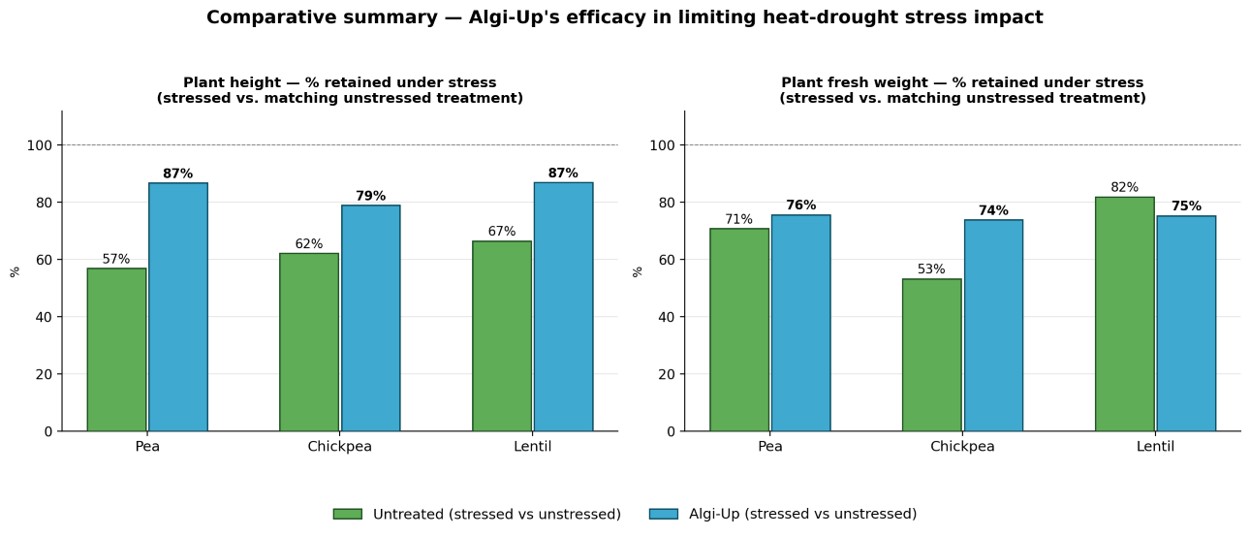
Across all three legumes tested, Algi-Up helps better preserve plant height coming out of the stress period:
| Crop | Height retained under stress | Fresh weight retained under stress |
|---|---|---|
| Pea | 87% (Algi-Up) vs 57% (untreated) | 76% (Algi-Up) vs 71% (untreated) |
| Chickpea | 79% (Algi-Up) vs 62% (untreated) | 74% (Algi-Up) vs 53% (untreated) |
| Lentil | 87% (Algi-Up) vs 67% (untreated) | 75% (Algi-Up) vs 82% (untreated) * |
* In lentil, the fresh-weight gap under stress is not statistically significant between treated and untreated plants; however, without stress, Algi-Up-treated plants show a significantly higher fresh weight than the untreated check (1.62 g vs 1.44 g) a growth-promoting effect worth investigating independently of stress protection.
In pea and chickpea, Algi-Up’s protective effect also shows up in the final fresh weight of stressed plants, with a gain of 5 to 21 percentage points over the untreated check.
No phytotoxicity, confirmed crop safety
Across all three trials, no phytotoxicity symptoms were observed, regardless of treatment or crop. This result confirms Algi-Up’s good crop safety at the tested rate (1 L/100 L) and its suitability for regular in-season use, including on sensitive crops such as grain legumes.
Towards more climate-resilient agriculture
These results, obtained independently and consistently across three different species, reinforce the case for Algi-Up as a preventive biostimulation solution against abiotic stress. Applied ahead of high-risk periods (heat peaks, irrigation restrictions), Algi-Up supports a more climate-resilient approach to farming, alongside existing agronomic practices.
Trials run in accordance with FAO guidance on climate adaptation in agriculture, which identifies heat and water stress as a growing constraint on crop productivity worldwide.
Interested in trialling Algi-Up on your crops, or discussing your climate-stress protection strategy with our biosolutions team?
Get in touchSources: Res Agraria final reports, protocols RA 26 016/017/018 BNS IT 01.


